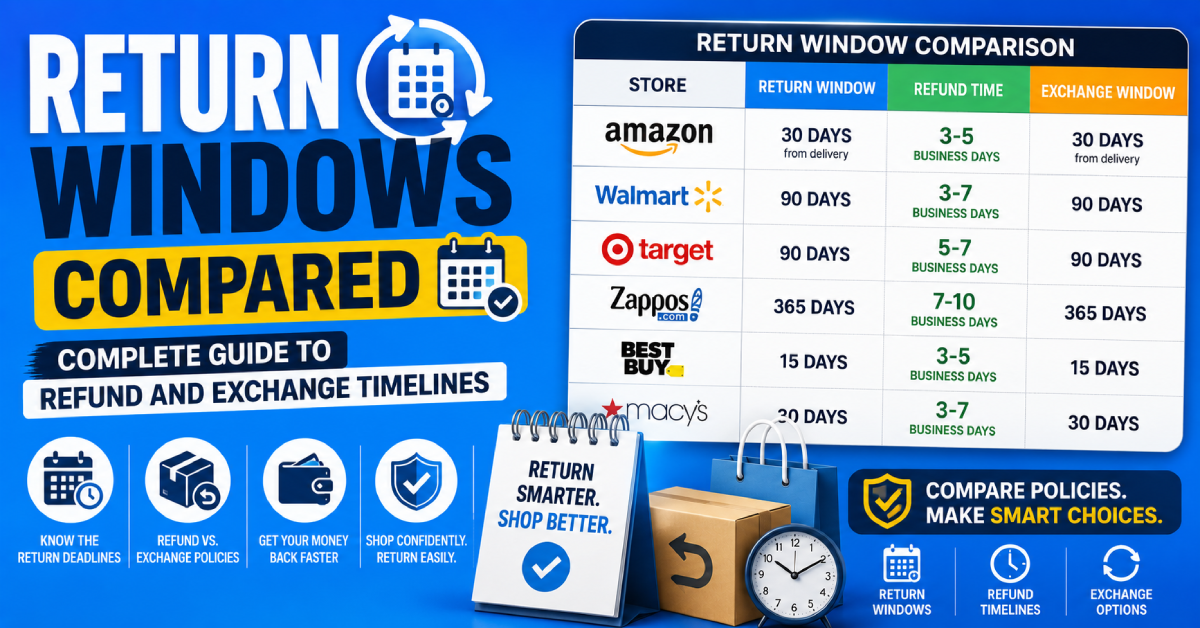
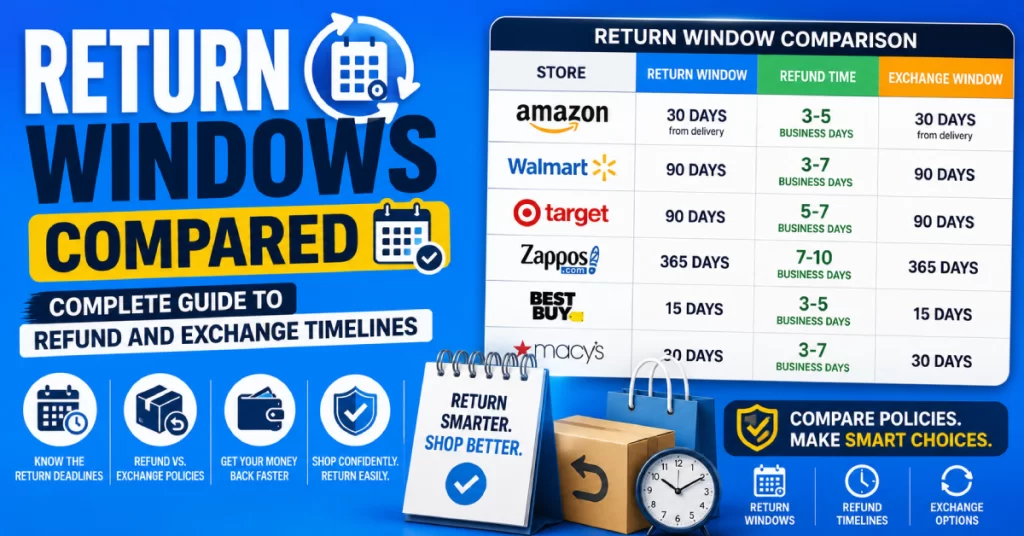
Most shoppers assume 30 days is standard. It’s not. Return windows vary wildly across major retailers — and knowing which stores are generous can save you real money when something doesn’t work out. Miss your window by a day and you’re stuck. Know it in advance and you shop with confidence. This guide breaks down exactly how long each major retailer gives you, which stores stand out with extended periods, what triggers shorter deadlines, and how to avoid losing your refund entirely. For a full breakdown by store, our return policy information hub has every major retailer covered.
Return Windows — Quick Overview
| Store | Standard Window | Extended / Exceptions |
| Costco | Unlimited (most items) | 90 days for electronics |
| Nordstrom | No set limit | Case-by-case basis |
| DSW VIP Elite | 365 days | Standard: 60 days |
| Target | 90 days | 120 days for RedCard holders |
| Walmart | 90 days | 30 days for electronics |
| Macy’s | 90 days | 30 days for small electrics |
| Home Depot | 90 days | 30 days for major appliances |
| Lowe’s | 90 days | 30 days for appliances |
| Best Buy | 15–30 days | 15 days for most; Elite Plus gets 45 |
| Sephora | 60 days (full refund) | 90 days for store credit |
| Ulta | 60 days | 60 days with receipt |
| H&M | 30 days | Holiday extension Jan 31 |
| DSW Standard | 60 days | Holiday extension Jan 31 |
What Are Return Windows?
Return windows are the time frames retailers give customers to send back or exchange a purchase. The clock usually starts from the purchase date or delivery date, depending on the store.
Some stores make it easy to return things by having a clear deadline.. Other stores add in extra things that can affect whether you can return something like whether you are a member, how you paid or what kind of thing you are returning. A few, like Costco and Nordstrom, take a much looser approach and rely more on judgment than hard cutoffs.
Knowing the refund deadline before you buy — not after — is what separates a smooth return from a stressful one.
Stores With the Longest Return Windows
Some retailers are genuinely generous. Others only look that way until you read the fine print. Here’s who actually gives you the most time.
Costco: Unlimited for Most Items
Costco sits at the top. No hard deadline on most merchandise. You can return a jacket two years later if it doesn’t hold up. The catch is electronics — those follow a 90-day window. But for general goods, Costco’s policy is among the loosest in retail.
The Costco return policy guide breaks down exactly which categories fall outside the unlimited window and what membership holders need to bring for a hassle-free return.
Nordstrom: No Set Time Limit
Nordstrom doesn’t publish a fixed return deadline. Returns are handled case by case, based on condition and purchase history. That sounds ideal — and often is. But it also means there’s no guarantee. Staff use judgment, and worn or damaged items still get rejected.
DSW VIP Elite: 365 Days
For frequent shoe shoppers, DSW’s VIP Elite tier unlocks a full year to return. Standard members get 60 days. The gap between tiers is significant. If you buy often enough to qualify for Elite status, that return window alone is worth the upgrade.
Check the DSW return window guide to see how the tier system works and whether the upgrade makes sense for your shopping habits.
Target RedCard Holders: 120 Days
Target gives standard shoppers 90 days. Pay with a RedCard and that stretches to 120 days automatically. No application needed mid-return — you just need to have used the card at checkout. For Target regulars, that extra month matters more than it sounds.
The Target return window details page covers which product categories still carry shorter windows even for Red Card holders.
The 90-Day Standard — Who Follows It?
Most major retailers cluster around 90 days for general merchandise. Walmart, Macy’s, Home Depot, and Lowe’s all use this as their baseline. But 90 days at the headline level doesn’t always mean 90 days across the board.
What a Return Policy After 30 Days Looks Like
Electronics are the most common exception. Walmart drops electronics for 30 days. Best Buy goes even shorter — 15 days for most items, 30 for members. The return policy after 30 days situation catches a lot of shoppers off guard because they assume the headline window covers everything in the cart.
Appliances are another trouble zone. Home Depot cuts major appliances to 30 days from their standard 90. Lowe’s does the same. Buy a refrigerator and you’ve got one month — not three.
You can compare store return rules side by side for the retailers most relevant to your shopping habits. Knowing the category exceptions before buying is the move.
Return Policy After 60 Days — The Middle Tier
Sephora sits at 60 days for full refunds, with store credit available up to 90 days. Ulta matches the 60-day window with a receipt. Both beauty retailers tighten rules on opened or used products — condition matters just as much as timing.
The Ulta return window details page covers what counts as “gently used” versus fully used, which affects whether you get cash back or store credit.
According to Costco’s official return policy page, the unlimited return policy covers most merchandise — with electronics, diamonds, and cigarettes as the notable exceptions.
Return Policy After 90 Days — What’s Left?
Past 90 days, most standard retailers close the door. Walmart won’t extend it. Home Depot won’t either. Macy’s cardholders get a longer window, but standard customers hit the wall at 90. The return policy after 90 days is almost always a dead end unless you’re shopping at a store that specifically offers extended or unlimited windows.
One exception worth knowing: DSW VIP Elite members can still return past 90 days — all the way up to 365. And Costco members can return most items regardless of how much time has passed.
Stores That Go a Full Year — or Beyond
Return Policy After One Year
Very few retailers formally support a return policy after one year. Costco is the clearest example for general merchandise. Nordstrom gets close with its case-by-case approach. DSW VIP Elite members have a defined 365-day window — which is the most structured year-long policy in mainstream retail.
Beyond that? Most stores don’t go there. A few will make exceptions for defective products, but that’s a manufacturer warranty conversation, not a standard retail return.
The Macy’s return window details page is a good reference point for understanding how a major department store handles loyalty-based extensions versus hard cutoffs for standard customers.
Late Return Policy Exceptions
Even outside official windows, exceptions happen. Late return policy exceptions usually fall into two buckets: defective items and loyalty member perks.
Defective products can often be returned outside the standard window — but documentation matters.When you have photo evidence, a purchase record and a documented conversation with the customer service team before visiting the store your case becomes much stronger. The customer service team can look at the photo evidence and the purchase record.
Loyalty tiers are the other path. Target RedCard, DSW VIP Elite, Macy’s Star Rewards, and Best Buy Elite Plus all unlock extended windows that non-members don’t get. If you’re a regular at any of these stores, signing up changes the return math.
For Best Buy’s tiered system specifically, the Best Buy return window details covers how Elite and Elite Plus members get different treatment from standard shoppers at checkout.
5 Tips for Getting the Most Out of Any Return Window
- Know the category exceptions before you buy. A 90-day policy means nothing if electronics drop to 30. Check the fine print for whatever you’re purchasing — not just the headline number.
- Link purchases to loyalty accounts. Target RedCard, DSW VIP, and Macy’s Star Rewards all extend your window automatically. Don’t leave that benefit on the table.
- Screenshot your confirmation email immediately. Proof of purchase speeds up every return, especially when the window is tight. Do it the day the order confirms.
- Contact customer service before the window closes. For the return policy after 60 days, reaching out early — even just to ask — opens more options than showing up cold at the service desk.
- Document defects on day one. If something arrives broken or fails early, photograph it immediately. That documentation is your strongest argument for a late return policy exceptions case. Browse shopping refund guides for more tips on handling edge-case returns across different store types.
Conclusion
Return windows range from 15 days at Best Buy to unlimited at Costco — and every point in between matters depending on what you bought and where. Electronics almost always carry shorter deadlines. Loyalty members get more time at most major stores. You can still find stores that have return policies if you look. Stores like Costco and Nordstrom give you more time to return things than a lot of other stores. If you know what the rules are before you buy something you can protect your money. Go to Return Policy Info to learn more about return policies.
Found this helpful? Check more return policy guides.
Frequently Asked Questions
What are return windows in retail?
Return windows are the set time frames stores give customers to return or exchange a purchase. Most run 30–90 days from purchase or delivery. Some stores tie the window to loyalty tiers or payment methods. Return windows vary widely — Costco offers unlimited time on most items while Best Buy drops to 15 days for standard members.
Which stores have the longest return windows?
Costco has a return policy. You can return things you buy from them without worrying about a deadline. Nordstrom is also very flexible. They look at each return individually. Decide what to do. DSW VIP Elite members get 365 days. Target RedCard holders get 120 days. These are the longest formal return windows available at major US retailers in 2026.
What happens when a return policy after 30 days expires?
Most stores close the return window entirely after 30 days if that’s the set limit. Electronics at Walmart, Best Buy, and Home Depot all follow short windows.The rules get stricter after the deadline. Sometimes customer service will make a one-time exception, loyalty members get treatment or you can use the manufacturer warranty to fix a defective product.
Can I return something after 90 days?
At most standard retailers, no. The return policy after 90 days is typically a hard stop. Exceptions exist at Costco (unlimited on most items), DSW VIP Elite (365 days), and Nordstrom (case by case). Defective items may qualify for exceptions at other stores — but contact customer service and bring documentation before attempting a late return.
Do loyalty programs really extend return windows?
Yes, and significantly. Target RedCard adds 30 days to the standard window. DSW VIP Elite goes from 60 days to 365 days. Best Buy Elite Plus extends from 15 to 45 days. If you shop regularly at any of these stores, signing up for the loyalty program changes your return window math considerably.
What are late return policy exceptions?
Late return policy exceptions are situations where a store accepts a return past its official deadline. These usually apply to defective products, loyalty members with extended tiers, or holiday purchase windows. They’re not guaranteed — documentation, a clean purchase history, and contacting customer service early all improve your chances of a successful late return.