
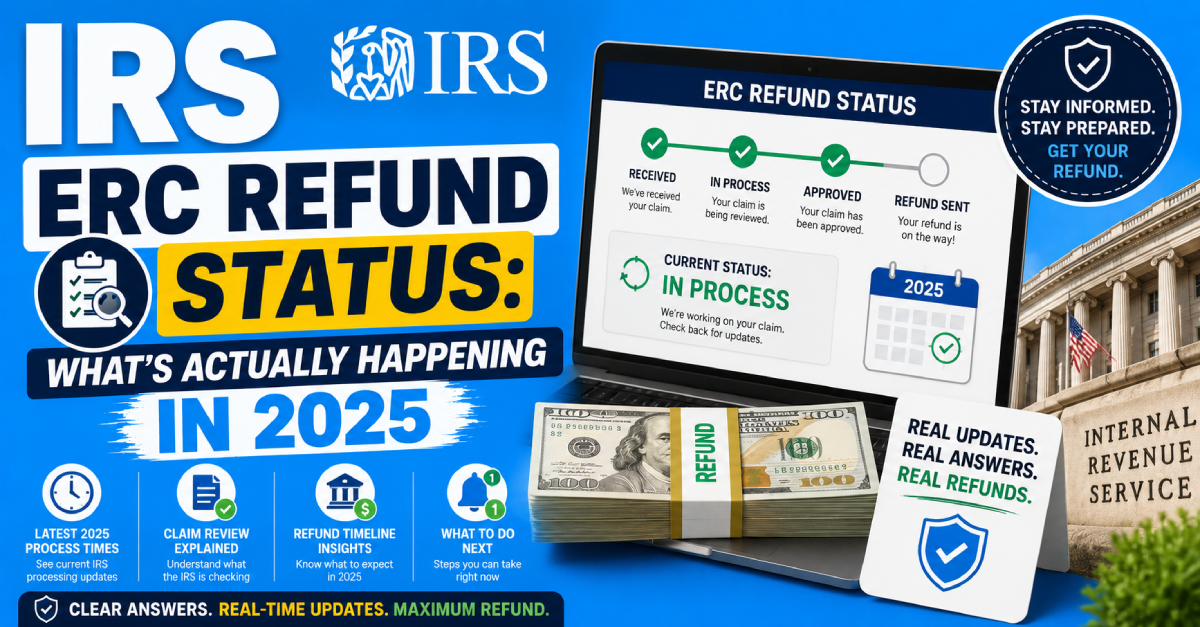
Small business owners have been waiting. Some since 2021. Phones going to voicemail, online portals showing nothing, and zero clarity on when — or if — the money arrives. If you’ve been chasing your IRS ERC refund status and hitting walls, you’re not alone. Tens of thousands of legitimate businesses are in the exact same spot.
This guide cuts through the noise. This guide tells you what the Employee Retention Credit is, why there are long delays and what you can do today to help your Employee Retention Credit claim move forward. While you’re sorting federal refund issues, our return and refund policy hub covers broader consumer refund topics worth bookmarking.
The IRS Employee Retention Credit information center has the official program details — and it’s worth reading if you haven’t yet.
IRS ERC Refund Status — Quick Overview
| Information | Details |
| Program Name | Employee Retention Credit (ERC) |
| Also Known As | ERTC — Employee Retention Tax Credit |
| Who Qualifies | Employers impacted by COVID-19 in 2020–2021 |
| Credit Amount | Up to $5,000 per employee (2020); up to $21,000 per employee (2021) |
| How to Claim | Filed via amended payroll return — Form 941-X |
| Current IRS ERC Refund Status | Backlogged; thousands of claims still pending as of 2025 |
| Processing Time | Originally 90 days; now 12–24+ months for many claims |
| IRS Fraud Crackdown | Moratorium placed on new claims Sept 2023; lifted selectively in 2024 |
| Voluntary Disclosure Program | IRS offered settlement for improper claims — deadline passed March 2024 |
| How to Check Status | IRS business tax account portal or call 1-800-829-4933 |
| Red Flags IRS Watches For | Third-party promoter involvement, inflated credit amounts, supply chain claims |
| Official IRS Page | IRS.gov/erc |
What Is IRS ERC Refund Status?
The term IRS ERC refund status describes the current processing position of your Employee Retention Credit claim within the IRS system.
When the pandemic was happening the Employee Retention Credit was one way the government helped businesses. It helped businesses that kept paying their employees even when things were tough. If a business was closed or if they made a lot money in 2020 and 2021 they could get some money back. Usually businesses got this money by filling out a payroll tax return using Form 941-X.
The problem? Millions filed. Many filed incorrectly. A flood of fraudulent submissions followed. The IRS got buried. Terms like ERC processing delays, amended return backlog, and payroll tax credit audit all became part of the same frustrating story for legitimate business owners trying to track their money.
Why Is the ERC Backlog Still a Problem in 2025?
Nobody expected this to drag on so long. But here’s what actually happened.
The Fraud Wave That Changed Everything
Things changed in 2023 when the IRS saw a growing number of Employee Retention Credit applications that might not be legitimate. Some helpers were taking a percentage of the expected Employee Retention Credit between 15% and 25% when they helped businesses submit claims. Not all of these claims were real. Some had inflated numbers and others were from companies that did not actually qualify for the Employee Retention Credit.
The IRS response was swift and blunt. In September 2023, they announced a moratorium on processing new ERC claims. Existing submissions got audited in bulk. Thousands of businesses with legitimate claims got caught in the same net as fraudulent ones.
Unclaimed IRS tax refunds had already been making headlines — but the ERC situation added a whole new layer of complexity on top of the existing backlog.
Where Things Stand Right Now
The moratorium lifted — partially — in 2024. The IRS began working through what they called the “lowest risk” claims first. High-risk and complex claims stayed frozen.
Irs layoffs tax refunds audits became a real concern in early 2025. Staff reductions across IRS divisions meant fewer hands processing an already massive pile. If your claim involves any complexity — supply chain disruptions, partial shutdowns, third-party promoter involvement — it’s likely still sitting in a review queue.
To check the full guide here on how refund delays affect your broader financial planning, our resource hub has relevant breakdowns.
How to Actually Check Your ERC Refund Status?
You have a few options. None of them are instant. But they’re better than wondering.
Using the IRS Business Tax Account Portal
This is your first stop. Log into your IRS business account at IRS.gov and look under your business’s tax records. You can see whether your Form 941-X has been received, if it’s under review, and in some cases whether a refund has been issued.
Not everything shows up here — older amended returns sometimes have limited visibility — but it’s the most direct tool available.
Calling the IRS Directly
The IRS business line is 1-800-829-4933. Be ready to wait. IRS layoffs in 2025 hit customer service staffing hard, and hold times have stretched significantly.
When you get through, have your EIN, the tax period in question, and your Form 941-X filing date ready. The agent can pull up your claim’s status and tell you if it’s been assigned for review or is still in the general queue.
Working With a Payroll Tax Specialist
If your claim is complex or you used a third-party promoter, a payroll tax attorney or CPA with ERC experience is worth the cost. They can communicate directly with the IRS Practitioner Priority line — which moves faster than the general business line — and spot issues before they become formal audits.
The IRS $1 billion in unclaimed 2021 tax refunds story got a lot of attention. But ERC money dwarfs that figure. The total value of pending ERC claims in the system runs into the tens of billions. Your piece of that matters.
ERC and the Broader Refund Picture in 2025
A few things are happening at the same time that affect ERC timelines.
IRS $3000 Refund June 2025 — Is ERC Part of That?
Not directly. The IRS $3000 refund June 2025 figure people are seeing online relates mainly to individual income tax refunds for households claiming family credits. ERC is a business payroll credit — a completely separate system.
But the staffing and processing pressures overlap. Fewer IRS employees across all divisions means slower movement everywhere, including ERC.
What About the IRS Tax Refund Average Increase?
Again — different population. The IRS tax refund average increase trend applies to individual filers, not business payroll tax credits. Your ERC claim won’t benefit from that trend.
What it does tell you is that the IRS is processing high volumes across multiple refund types simultaneously. For a small agency dealing with IRS layoffs, that’s a real strain.
Unclaimed IRS tax refunds 2021 added another layer of pressure in early 2025 as the April 15 deadline pushed thousands of late filers into the system at once.
For broader refund tracking tips across different situations, browse our helpful shopping guides — some consumer refund principles translate across contexts.
Tips to Speed Up Your ERC Claim
- Check your IRS business portal weekly. Status can change without notification. Log in regularly rather than waiting for a letter.
- Don’t refile your 941-X. Duplicate submissions flag your claim for additional review. It slows things down, it doesn’t speed them up.
- Keep your documentation airtight. The IRS is auditing ERC claims heavily. Payroll records, revenue comparisons, government order documentation — have all of it organised and ready.
- Watch your mailbox. The IRS sends notices by mail, not email. A Letter 6612 or similar notice means action is needed. Missing it causes more delays.
- If you used a promoter, review your claim carefully. Unclaimed IRS tax refunds tied to inflated ERC claims are now being clawed back. If your credit amount seems too high, get a second opinion before the IRS contacts you.
- Ask about the IRS ERC refund status specifically when you call. Be direct — ask if your claim is in the standard queue, under audit, or flagged for promoter review. Each has a different resolution path.
Conclusion
The IRS ERC refund status situation is frustrating — but it’s not hopeless. Legitimate claims are still being processed. The IRS is working through the backlog, even if slowly.
Stay proactive. Check your portal. Keep your records clean. Don’t refile. And if complexity is holding your claim up, a qualified tax professional is worth every penny at this stage.
Visit Return Policy Info for more guides on refunds, consumer policies, and financial claims that affect your bottom line. Found this helpful? Check more return policy guides.
Frequently Asked Questions
What is IRS ERC refund status?
For businesses that are waiting for their Employee Retention Credit funds the IRS Employee Retention Credit refund status shows how far the claim has gone. You can look up the status of your Employee Retention Credit claim on the IRS business portal. Call 1-800-829-4933 for updates. A lot of Employee Retention Credit claims that were filed between 2021 and 2023 are still delayed because the IRS is doing checks for fraud.
How long does it take to get an ERC refund in 2025?
Processing times vary widely. Simple, low-risk claims can resolve in a few months. Complex claims or those involving third-party promoters are taking 18–24 months or longer. IRS ERC refund status checks through the business portal give the most current timeline for your specific claim.
Why is my ERC claim still pending?
There are a lot of Employee Retention Credit claims that have not been resolved yet because of the fraud issue that started in 2023 and the audits that happened after that. It took longer to process these claims after the IRS had fewer staff members in 2025, which affected many departments. If a claim is linked to someone who helps people file claims or if it is about whether a company’s eligible because of its supply chain or if the credit amount is very large it will be looked at more closely and this can cause more delays.
Can I refile my ERC claim to speed it up?
A second Form 941-X filing usually creates unnecessary complications for your Form 941-X claim. When duplicate Form 941-X submissions appear in the system the IRS may conduct reviews before moving forward with your Form 941-X claim. When refiling your Form 941-X you should keep your original Form 941-X records and reference information. If your Form 941-X claim has been waiting for more than a year you should contact the IRS directly or speak with a payroll tax specialist about your Form 941-X claim.
What documents do I need to support my ERC claim?
Documents can make all the difference in an Employee Retention Credit claim. You should get your payroll records for the quarters that apply your records that show the revenue reduction that is required of any government mandates that affected how your company operates and details about your employees. Since audits are becoming more common it is an idea to have complete records. This can protect you from delays and challenges.
Is the ERC program still open in 2025?
Most businesses cannot file an ERC claim now. The IRS stopped claims in September 2023 and now that time is over. If you did not file for the ERC you should talk to a tax advisor now to see if there is anything you can do.