My neighbor’s kid — 23, never had a single issue with wisdom teeth — went in for a routine cleaning last spring. Dentist pulled up the X-ray and said, almost as an afterthought, “You know you’re missing two of these, right?” The kid had no idea. Never felt anything, never been told, never given it a second thought.
He left the appointment genuinely unsure whether that was good news or bad news.
I’ve thought about that a lot since. Because we grow up hearing about wisdom teeth the same way we hear about puberty or college — like it’s just something that happens to everyone eventually, and the only question is how badly it goes. But that’s not quite right. Not even close, actually.
First Thing: No, Not Everyone Gets Wisdom Teeth
Let’s just get this out of the way.
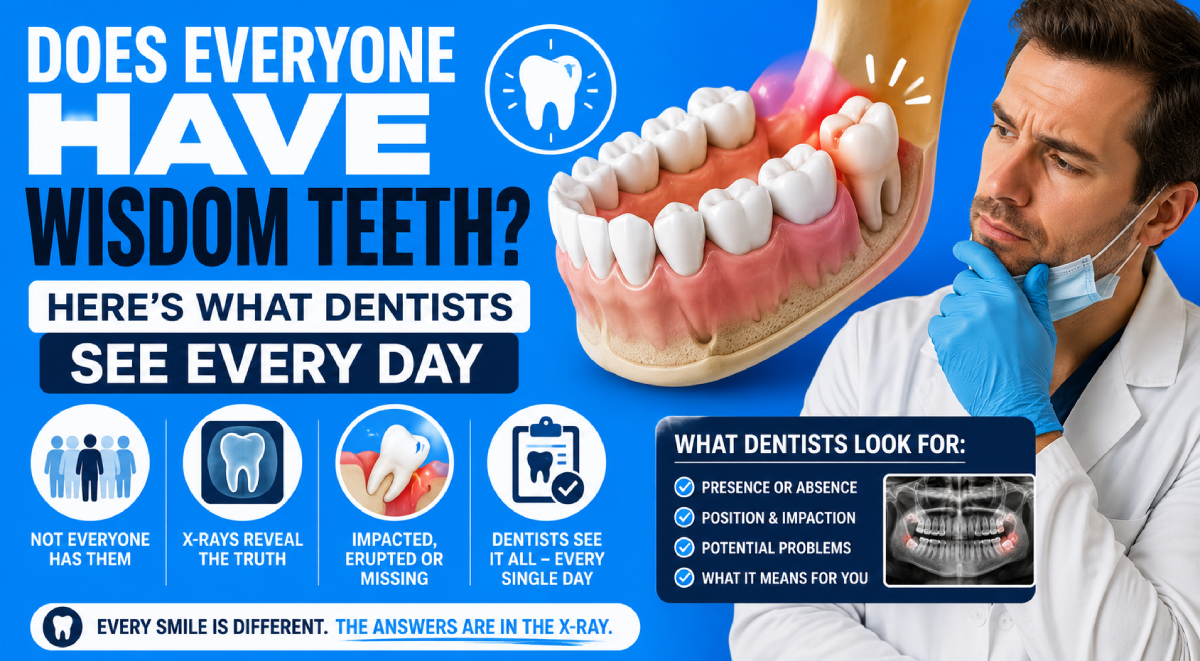
Studies have put the number of people missing at least one wisdom tooth somewhere between 5 and 37 percent — a wide range, because it depends heavily on the population being studied. Some groups show numbers higher than that. And a smaller but real percentage of people never develop a single wisdom tooth, ever, without anything going wrong. Their bodies just… didn’t make them.
The proper term is third molar agenesis. It means one or more third molars never formed in the first place — not impacted, not hiding somewhere below the gumline. Just absent.
And here’s what makes it interesting: it’s not random. It runs in families. Specific genes — PAX9 and AXIN2 are the most studied — influence whether third molars develop during fetal growth. Variations in those genes can switch the process off entirely or partially. If your parents or grandparents were missing wisdom teeth, your odds of being missing one (or several) go up.
Ethnic background also plays a meaningful role. People of East Asian ancestry show notably higher rates of missing wisdom teeth compared to people of European ancestry, in study after study. Various Indigenous populations show elevated rates too. This reflects long-term evolutionary divergence — different ancestral groups, different selection pressures, different frequencies of the genetic variants that build (or don’t build) third molars.
Why We Have Them at All — the Actual Story
Third molars exist because our ancestors lived brutally hard lives, at least orally speaking.
The prehistoric human diet was a demolition job. Uncooked meat, roots and tubers dug from soil, rough fibrous plants, hard seeds and nuts — chewing this stuff day after day destroyed teeth at a rate we can barely imagine now. Skulls from early human populations show heavy molar wear that would have left people with almost no chewing surface by their thirties. Extra molars weren’t a backup system; they were part of the main system.
The jaw to house those molars was correspondingly large. Broader, deeper, more robust than most modern human jaws. There was room.
Then things changed. Fire changed them first — cooked food is dramatically softer than raw food, and that shift alone reduced the mechanical demands on the jaw enormously. Agriculture changed them further. Over thousands of years, human jaws gradually became smaller, partly in response to reduced chewing loads during childhood development (bone grows in response to stress, and jaws that aren’t worked hard don’t grow as big), and partly through genetic shifts across populations adapting to new diets.
The third molars kept developing on the same old genetic schedule. The jaw didn’t wait for them.
That mismatch is why so many people end up in an oral surgeon’s chair. It’s not a disease or a disorder. It’s just the pace of evolutionary change being slower than the pace of dietary change. We changed what we ate in a few thousand years. The genetic programs that build our teeth are working with instructions that are tens of thousands of years old.
When They Do Show Up — What Can Go Wrong
The trouble starts when a wisdom tooth tries to emerge and runs into a wall.
When a third molar can’t fully erupt — because the jaw is too small, because there’s another tooth in the way, because the angle is wrong — it becomes what dentists call an impacted tooth. This isn’t one thing. Impaction comes in different types depending on how the tooth is oriented:
A mesially impacted wisdom tooth tilts forward toward the second molar. It’s the most common type. Over time, the pressure it exerts on that neighboring tooth can dissolve the second molar’s roots — a process called root resorption — often without causing significant pain until real damage has been done.
A horizontally impacted tooth lies completely sideways in the jaw, pushing directly into the root of the tooth in front of it. Often visible on X-rays as a tooth that looks like it got confused about which direction to grow.
A partially erupted tooth breaks through the gum surface but doesn’t fully emerge. This creates an operculum — a flap of gum tissue covering part of the crown. That flap is a trap. Food and bacteria collect underneath it in a space you cannot adequately brush or floss. The resulting infection, called pericoronitis, causes swelling, pain, and sometimes difficulty opening the mouth. It can recur repeatedly over years.
Then there are the quiet complications that don’t cause symptoms until they’re already serious: odontogenic cysts that form around unerupted teeth and slowly expand through the alveolar bone; low-grade chronic infection spreading to adjacent teeth; shifting of neighboring teeth from sustained impaction pressure.
Around five million wisdom tooth extractions are performed in the US every year. The surgery is routine. But “routine” only means the surgeons do it a lot — for the patient, it’s still a procedure with recovery time, real discomfort, and a soft food period that always seems longer than expected.
But Here’s What Often Goes Unsaid
Not every wisdom tooth is a problem.
If a third molar erupts fully, comes in at a reasonable angle, clears the gum line completely, fits within your bite, and you can actually reach it with floss — there’s no strong clinical case for removing it. Plenty of people carry all four wisdom teeth into their fifties and sixties without ever having an issue.
The “just pull them all before they cause problems” approach has become less universal in recent years. Some research has raised questions about whether prophylactic removal of asymptomatic, properly erupted wisdom teeth provides enough benefit to justify the surgical risk. The conversation among dental professionals is more nuanced than it used to be.
What actually drives the decision to remove a wisdom tooth comes down to a few things:
How it’s positioned. A tooth tilting sharply into a neighboring molar is a future problem. A tooth coming in straight is a much lower-risk situation.
Whether it can be cleaned. A wisdom tooth you genuinely cannot floss is going to develop decay or gum disease eventually, regardless of how nicely it came in. That’s not hypothetical — it’s a near-certainty over a long enough time horizon.
When in life the patient is. Wisdom tooth removal in the late teens, before roots are fully formed, tends to be faster, cleaner, and easier to recover from. The same extraction in the late thirties — fully formed roots, possibly curved, anchored in denser bone — is a more complex procedure with a longer healing period.
Whether symptoms are already present. Recurrent pericoronitis, pain, signs of cyst formation, adjacent tooth damage showing on X-rays — any of these tips the calculus toward removal.
A dentist worth their license walks through your specific panoramic radiograph with you and explains what they’re actually seeing, not what “typically” happens. If you’re being handed a referral to an oral surgeon without that conversation, it’s reasonable to ask for it.
Symptoms That Mean You Should Stop Waiting
Some people feel their wisdom teeth coming in. Some don’t. The ones who feel it tend to notice:
Pressure or dull aching deep in the back of the jaw — often the first sign. It doesn’t always feel like a toothache. Sometimes it radiates toward the ear or up into the temple. People mistake it for sinus pressure or tension headaches.
Swelling or tenderness in the gum behind the last molar — the early stage of pericoronitis. The tissue looks puffy and red, and pressing on it is uncomfortable.
A persistent bad taste or unexplained bad breath — bacteria under a gum flap produce compounds that smell and taste bad. If your dental hygiene is otherwise solid and this keeps happening, it’s worth investigating.
Jaw stiffness, especially mornings — can be hard to distinguish from TMJ-related symptoms, but when it’s combined with back-of-jaw tenderness, wisdom teeth move up the list.
Visible white edge at the very back of the gum — you can sometimes actually see the top of the tooth beginning to push through.
None of this automatically means surgery. It means it’s time for a current X-ray and a real conversation rather than continuing to wonder.
What If You’re in Your Thirties and This Has Never Come Up
Two possibilities.
One: you’ve had X-rays that showed no wisdom teeth developing, or you had them removed at some point. In that case, nothing to think about.
Two: you’ve never had a panoramic X-ray, or it’s been many years since you have. In that case, it’s genuinely worth getting one — not because wisdom teeth in their thirties are common, but because impacted teeth can sit quietly in the jaw for a very long time before starting to cause problems, and because changes that do occur tend to be easier to manage before they become urgent.
Wisdom teeth erupting in the thirties or even forties do happen, though it’s not typical. More relevantly, a tooth that’s been impacted since your twenties and hasn’t bothered you might still be slowly doing things to the surrounding bone or adjacent roots that won’t announce themselves until later.
A Genuine Evolutionary Footnote
This part doesn’t change anything practical, but it’s worth knowing.
A research team at Flinders University in Australia published a study in 2019 examining microevolutionary changes in modern human anatomy. Among their findings: measurable increases in the rate of third molar agenesis across populations over roughly a century of data. More people today, proportionally, are born without wisdom teeth than a hundred years ago.
Their interpretation was that human evolution is still ongoing — that changing diets, changing patterns of tooth use, and possibly the increased survival of individuals who would previously have had more complications from impacted teeth has shifted the genetic landscape slightly. Over many generations, that shift adds up.
It’s going to take tens of thousands of years to resolve in any meaningful sense. But it means that being born without wisdom teeth isn’t an anomaly — it may be the direction the species is slowly moving, one small genetic frequency shift at a time.
Reference: Terms Worth Knowing
Third molar agenesis — the congenital absence of one or more wisdom teeth; a common developmental variation, not a disorder
Hypodontia — missing up to five permanent teeth by congenital absence; wisdom tooth agenesis is a subset of this
Dental impaction — failure of a tooth to fully erupt through the gumline due to obstruction from bone, tissue, or adjacent teeth
Mesial impaction — forward-angled impaction toward the neighboring molar; the most common impaction type
Pericoronitis — infection and inflammation of gum tissue around a partially erupted tooth; a primary clinical driver of wisdom tooth removal decisions
Operculum — the soft tissue flap overlying a partially erupted tooth; site of bacterial accumulation in pericoronitis
Root resorption — gradual dissolution of tooth root structure caused by pressure from an impacted adjacent tooth
Odontogenic cyst — a fluid-filled sac that forms from tooth-forming tissue around an unerupted tooth; can silently erode surrounding jawbone over time
Alveolar bone — the jaw bone that houses tooth roots; subject to erosion from untreated cysts and infection
Panoramic radiograph / dental panoramic tomograph — a full-arch X-ray used to assess wisdom tooth number, position, root development, and bone condition; the standard diagnostic tool for third molar evaluation
PAX9 / AXIN2 — genes involved in tooth development; variants in these genes are associated with third molar agenesis
Third molar eruption timeline — typically begins with initial calcification around age 7–10, crown formation through early adolescence, and eruption between ages 17–25; significant individual variation exists
The Bottom Line
Wisdom teeth are not universal. Whether you develop them, how many you develop, and what happens when you do is largely written in your genetics — and shaped by the jaw size you were born with and the evolutionary baggage that comes with being a modern human.
Not having wisdom teeth is not a defect. Having them and not needing them removed is genuinely possible. Having them cause serious problems is also common. The only way to know which category you fall into is a current panoramic X-ray and a dentist who takes the time to actually explain what’s on it.
That’s the whole thing, really.
Written for general informational purposes only. Not a substitute for professional dental advice, diagnosis, or treatment from a licensed oral health provider.